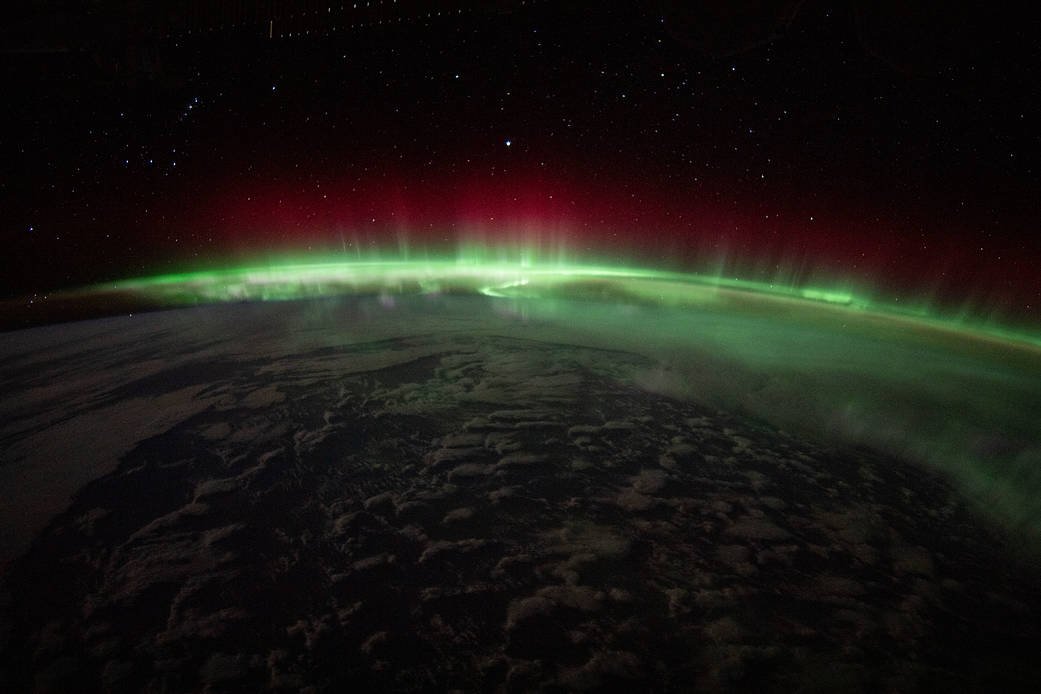
Auroras are light emitted by atmospheric particles after energy reaches them through Earth's space environment. Visibility also depends on local conditions.
An aurora can look like a curtain being pulled across the sky. Its movement is graceful, but the process behind it involves charged particles, magnetic fields and energy moving through the environment around Earth.
The light is not sunlight reflecting from clouds. It is produced in the upper atmosphere.
From the Sun to the atmosphere
The Sun continually releases a flow of charged particles known as the solar wind. Solar activity can also produce disturbances that interact with Earth's magnetic environment.
Energy transferred through that system can accelerate particles along magnetic-field pathways. When those particles collide with atoms and molecules high in the atmosphere, the atmospheric particles can emit light.
The result is the aurora. The connection to Earth's magnetic field helps explain why auroras are usually associated with high-latitude regions.
Different gases produce different colors
The color depends on the atmospheric particles involved and the conditions of their excitation. Oxygen contributes prominent green and red emissions, while nitrogen can contribute blue and purplish tones.
A photograph may show more vivid color than a person saw at the time. Cameras can collect light over a longer exposure and process it differently from human night vision.
That difference does not automatically make a photograph deceptive. A useful caption explains how the image was captured and whether its appearance was substantially altered.
A forecast is not a viewing guarantee
A forecast of increased geomagnetic activity concerns conditions in the space environment. Seeing an aurora from a particular location also depends on darkness, clouds, light pollution and the timing and position of the display.
A strong forecast does not move a cloud bank out of the way. Conversely, a modest display may still be interesting from a dark site at a favorable latitude.
Treat a forecast as a reason to check conditions, not a promise of a specific photograph.
Space weather can affect technology
Solar and geomagnetic disturbances can affect radio communication, satellites and, under some conditions, electricity infrastructure. The consequences depend on the type and strength of the disturbance and the systems exposed to it.
An aurora photograph alone cannot tell you whether your phone or local power network is at risk. Avoid treating every dramatic image as evidence of a major emergency.
For operational decisions, use current information from the relevant space-weather and local authorities. This article explains the mechanism; it is not a live alert.
Read a forecast carefully
Check when it was issued and which time zone it uses. Distinguish an observed condition from a prediction. Look for updates rather than relying on a screenshot shared without a date.
If you plan to observe, choose a safe location with permission to be there. Check ordinary weather and travel conditions as well as the sky forecast. Never look directly at the Sun without suitable solar-viewing equipment.
The aurora links a distant star to processes around our own planet. Understanding that link makes the display more than a pretty sky: it becomes visible evidence of an environment that is usually hidden from view.
Sources & further reading
Original explainers and practical examples, with technical background from the sources below. Source links reviewed 2026-10-03.
More context, fewer assumptions. About our editorial approach.